
Greene County Projected Release Dates
A projection is a sentence calculation based on the order and information available at that time. An actual release entry records that the person left the named facility. The two dates can differ. A minimum date may establish parole eligibility, while a maximum date marks the sentence boundary as lawfully computed. Neither should be relabeled as a firm pickup time.
Greene County Prison calculates local minimum and maximum dates after it receives the sentencing order. State sentences are calculated within PADOC. The public PADOC Inmate/Parolee Locator helps identify a current inmate or parolee, but its official public description does not promise a projected, minimum, maximum, tentative, or final-discharge field. If a live result shows a date, read the exact label. The parolee-side “Release Date” means release from incarceration to state supervision, not the end of the whole sentence.
Scheduled versus actual: A projected or minimum date is not proof of release. Confirm a past event with the facility's actual release record and any receiving agency.
Pretrial custody works differently. Without a sentence, no good-time or minimum-and-maximum formula can produce the exit date. Bail, a dismissal, a release order, or a transfer may end Greene County custody. A detainer can keep the person confined or send the person to another authority even after the local basis ends.
Find Greene County Projected Release Dates
The correct route depends on who holds the sentence. Greene County Prison and the county court handle a local sentence. PADOC handles a state sentence, even when the conviction arose in Greene County or the person is housed at SCI Greene. A court docket supplies the sentence and later orders, but the agency calculation addresses credit and custody details.
- Identify the facility and sentence. Distinguish Greene County Prison from SCI Greene. Check the booking number, court docket, or PADOC number before relying on a name match.
- Read the sentencing order. Use the UJS Case Search for the minimum, maximum, flat term, concurrent or consecutive structure, and later amendments.
- Route the calculation. For a county sentence, call Greene County Prison and ask about the official calculation. For a state sentence, seek PADOC Population Management and Sentence Computation confirmation.
- Check parole status separately. A county minimum requires judicial parole when applicable. A state minimum usually opens eligibility for discretionary Parole Board action.
- Check holds and later orders. A detainer, violation, corrected credit, or new court order may alter the expected release path.
- Confirm the event. Once the date passes, use the actual release entry, the PADOC status, a VINE event, and the receiving agency if transfer is shown.
The broader Greene County released inmate search explains how to reconcile the county record, court docket, PADOC, and receiving-agency systems after someone has left a roster. For a date that has not arrived, keep the result labeled as projected.
Note: Record the date of every search because court, facility, parole, and locator information can change at different points in the process.
Who Calculates Greene County Dates
Greene County has an unusually clear local rule. After a sentencing order reaches the prison, only a shift commander or a more senior prison employee may calculate and convey projected minimum and maximum dates. Other staff cannot give an authoritative computation. The Greene County Prison release and sentencing information also warns that other agencies may have to concur before actual release.
This rule protects against informal math based on an incomplete order. Sentence credit, overlapping cases, and authority from another agency can affect the calculation. If prison staff see a discrepancy in a court order, they cannot rewrite it. The issue belongs with the court or counsel. Once an older projection and an actual release entry conflict, the actual entry controls proof that the facility exit occurred.
Greene County Prison
855 Rolling Meadows Road
Waynesburg, PA 15370
Phone: 724-627-7780
Fax: 724-852-2536
Business hours: Monday through Friday, 8:00 a.m. to 4:00 p.m.
Give the full name, date of birth if needed to distinguish people, booking or commitment number, and court docket. Ask for the calculation tied to that custody episode. For a past event, request the actual release date and time, the release authority or transfer destination, and any public detainer disposition rather than an old estimate.
Greene County Minimum Date Routing
For a Greene County minimum-and-maximum jail sentence, staff start a parole application about ten days before the minimum. Greene County says the combined Acts 96 and 139 charges total $60 and must be paid to the Clerk of Courts before the application is complete. Review then moves through probation or parole, the district attorney, and the sentencing judge. The county estimates one to two weeks for normal routing.
The minimum can arrive before a signed parole grant. In that case, the person does not leave merely because the calendar reached the date. A county judge controls judicial parole. People confined for parole or probation violations do not reapply through the published process; the county says they leave when the violation sentence is complete, subject to a detainer or wanted status.
A flat magisterial sentence follows another path. The person completes the set term, but Greene County still checks for outside holds before release. The actual out date may thus reflect sentence completion and immediate transfer to another authority. “Released from Greene County Prison” does not always mean “released to the community.”
Pennsylvania Release Date Rules
Pennsylvania uses indeterminate sentencing for many confinement sentences. Under 42 Pa.C.S. § 9756, the court imposes a maximum and ordinarily sets a minimum that cannot exceed one-half of the maximum for total confinement. The minimum usually marks the earliest parole-eligibility point. It does not force release. The maximum remains the sentence endpoint as lawfully computed, unless credits or another valid order alter it.
State parole is discretionary under the Pennsylvania Parole Code, including 61 Pa.C.S. § 6137. Death and life sentences do not follow ordinary parole eligibility. A Board decision, approved release plan, institutional processing, and detainer review can all stand between eligibility and the actual exit. A favorable decision may also be lawfully rescinded before release.
Pennsylvania does not impose a universal rule that every state prisoner must serve 85 percent of the maximum. That shorthand should not be used to predict a Greene County or PADOC date. The federal good-conduct framework is different. Pennsylvania credits and release programs have their own statutes, eligibility limits, and agency findings.
Note: A sentence fraction is not a substitute for the signed order, official credit calculation, parole decision, and current hold review.
Greene County RRRI Date Limits
The Recidivism Risk Reduction Incentive, or RRRI, is a specific state program. It is not general “good time.” For an eligible person, Title 61 describes an RRRI minimum equal to three-fourths of an ordinary minimum of three years or less, or five-sixths when that ordinary minimum exceeds three years, with statutory rounding. The court and PADOC record must show that the person qualifies.
Reaching an RRRI minimum does not guarantee release. PADOC must address assessment, completion of the prescribed program plan, conduct, reentry planning, continued eligibility, and public-safety criteria. Statutory exclusions also apply. Short Sentence Parole under 61 Pa.C.S. § 6137.1 is another limited path with its own eligibility rules, not a right that covers all state prisoners.
For an exact state calculation, the sentence order and docket are inputs. PADOC Population Management and Sentence Computation is the appropriate confirming unit. The public locator may still help confirm identity, institution, and current jurisdiction, but a missing projected field should not be filled with homemade arithmetic.
Why Greene County Release Dates Change
A projection can change because the facts or legal authority behind it change. Some events alter the sentence computation. Others leave the calculation intact but stop release to the community. The distinction is vital when comparing a court order, prison estimate, and later custody record.
| Event | Effect on the date or release |
|---|---|
| Corrected time-served credit | Changes the official sentence calculation after custody time is verified. |
| Amended court order | May revise the term or how multiple sentences run. |
| Concurrent or consecutive ruling | Changes whether terms overlap or run one after another. |
| Parole grant, denial, or deferral | Determines whether eligible release occurs before the maximum. |
| Violation and recommitment | May return a parolee to custody and require a new calculation. |
| Detainer or wanted status | Can prevent community release or cause transfer to another authority. |
| Late outside authority | Can delay out-processing even when the local calculation is complete. |
Greene County Prison runs an NCIC check before release. The county says a detainer or wanted result keeps the person detained despite sentence completion. A detainer is a lawful hold from another agency. When local obligations end, the person may be surrendered to that agency. This is why a projected release date cannot answer where the person will go.
PADOC Greene County Date Lookup
The official PADOC locator guidance says the inmate side covers people currently under PADOC jurisdiction and is updated daily. Search with the last name or inmate number, then match the inmate number and birth details. Results can identify the institution, committing county, photo, and other identifying facts. County prisoners and people held by other states are excluded.
The manifest capture below comes from the Pennsylvania Inmate/Parolee Locator. It supports the identity and custody-search step, not a promise that every profile displays a projected date.
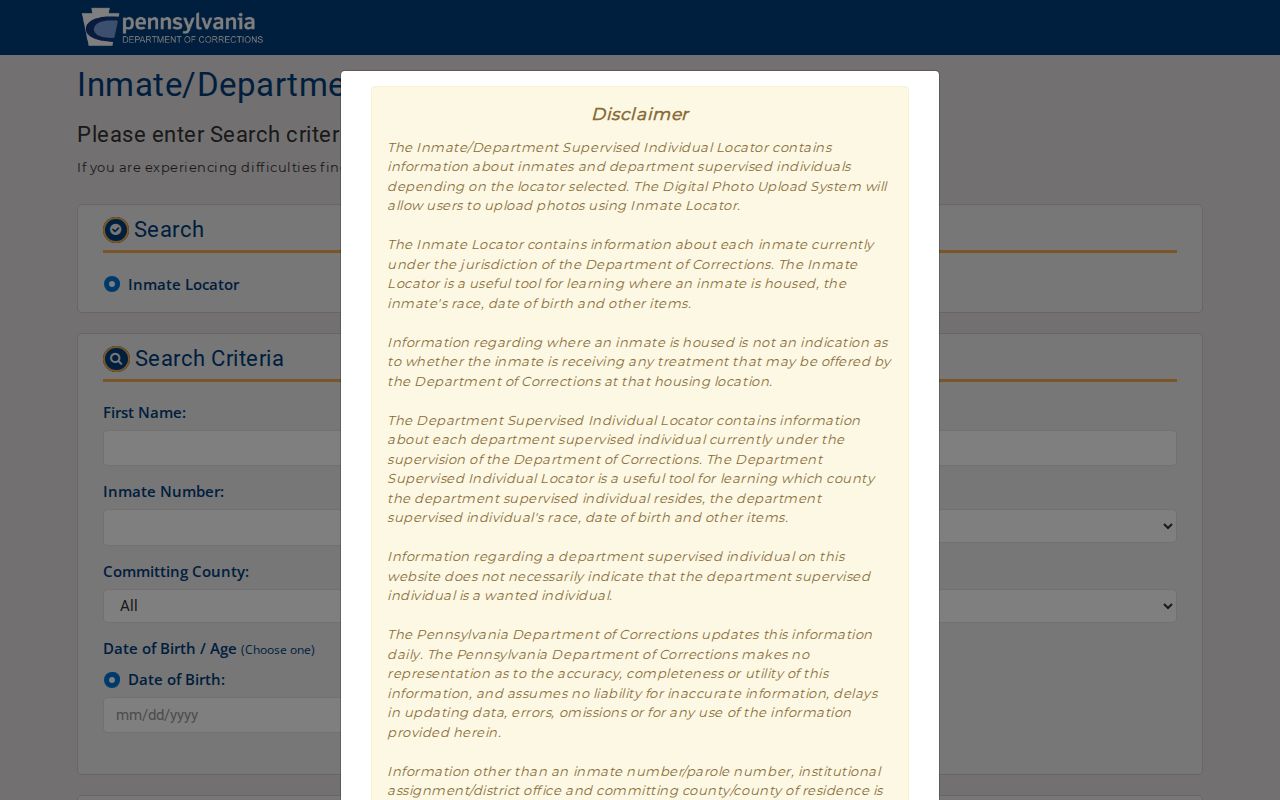
The locator screen helps separate a state prisoner from a Greene County Prison detainee. When exact minimum, maximum, or projected fields are absent, use the sentencing docket and request PADOC's official sentence computation instead of inferring a date.
A current parolee result may show a release date and district office. That release date marks the move from incarceration to state supervision. It is not final discharge. A fully discharged person may disappear from the locator because it is not a complete historical archive.
Note: A PADOC parolee release date marks departure from incarceration, while final discharge from the state sentence is a later event.
Confirm Greene County Actual Release
As the expected date approaches, compare the responsible facility, the court docket, and any parole action. PA SAVIN can send a reported custody-change alert through VINELink, but it should not be the only confirmation. The Greene County VINE inmate check explains how to match one person and register by phone, text, email, or app.
For a county sentence, call Greene County Prison for a time-sensitive question and request the final release entry for historical proof. For a state sentence, use PADOC and the Parole Board record. If a transfer or detainer is listed, check the receiving authority. The final record should state the actual date and time, release type or authority, and destination when public.
A projected date remains useful for planning. It should stay labeled as an estimate until the custodian records the exit. Court delay, parole processing, or an outside hold can change the path even on the expected day.